
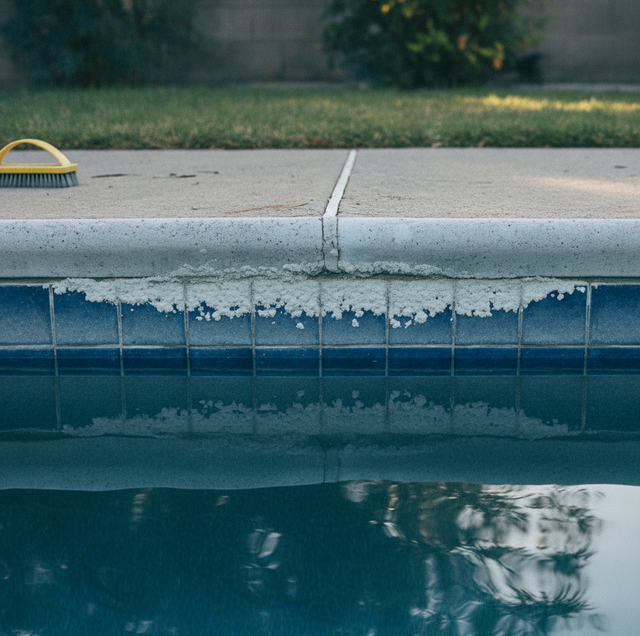
That chalky white or gray band riding along your waterline is not dirt you can scrub away on a Saturday afternoon. It is calcium scale, and it forms on a schedule set by your water, your climate, and your chemistry rather than your calendar. Understanding why it builds where it does tells you far more about cleaning frequency than any one-size number ever could.
Why Scale Shows Up Right at the Waterline
Pool water is never just water. It carries dissolved minerals, and calcium is the heavy hitter. As long as those minerals stay dissolved and moving through the water, they leave the tile alone. The problem starts where the water surface meets the air.
At the waterline, water is constantly evaporating. When a molecule of water lifts off into the air, it does not take its dissolved calcium with it. The mineral gets left behind, concentrated into the thin band of water that clings to the tile at the surface. Repeat that thousands of times a day, and the calcium load in that band climbs until it can no longer stay dissolved. It drops out of solution and bonds to the tile as a hard crust of calcium carbonate, sometimes with harder calcium silicate mixed in.
That is why the scale forms in a stripe at the waterline and not down on the pool floor or steps. The floor stays submerged and does not experience the same relentless evaporation-and-concentration cycle. The waterline is the one spot where water repeatedly meets air, minerals repeatedly concentrate, and deposits repeatedly harden in the same narrow band.
What Decides How Fast Your Tile Scales
Two pools on the same street can scale at very different rates. A handful of factors set the pace.
Water hardness: The more calcium your fill water carries to begin with, the less evaporation it takes to reach the tipping point where minerals drop out. Hard water scales faster because it starts closer to saturation.
Evaporation rate: Hot, dry, sunny, breezy conditions pull water off the surface quickly. Faster evaporation means faster mineral concentration at the waterline, which means faster crust formation. A pool baking in open sun all day builds scale more quickly than a shaded one, and this holds true across the whole year, not just in the hottest months. Winter's lower humidity can drive strong evaporation too, so the pressure on your tile is a year-round condition rather than a single-season event.
Calcium hardness and pH levels: When calcium hardness runs high and pH drifts up, the water is already primed to shed minerals. Push both above their comfortable ranges, and calcium will precipitate onto surfaces with very little provocation.
How much the pool gets used: Splashing, swimming, and the resulting water movement, plus the fresh water you add to replace what splashes out, all feed into how minerals cycle and concentrate near the surface.
Whether you keep the chemistry balanced: This is the factor you actually control. Balanced water holds its minerals in solution. Unbalanced water hands them to your tile.
So, How Often Does It Actually Need Cleaning?
Here is the honest, useful version of the answer: many pools do well with a professional waterline cleaning roughly once a year. That is a solid starting point for a typical, reasonably maintained pool.
But a starting point is not a rule. A pool fed by very hard water and sitting in a hot, dry spot with high evaporation can build a stubborn crust in as little as six to twelve months. On the other hand, a pool with softer water and consistently balanced chemistry can go comfortably longer than a year between professional cleanings.
The way to read your own pool is to watch the tile, not the calendar. When you see a defined band forming, when the surface feels rough and gritty under your fingertips where it used to feel smooth, or when brushing stops making any difference, the scale has hardened past the point of routine care. That is your pool telling you it is time, regardless of how many months have passed since the last cleaning.
Why Owner Cleaning Only Goes So Far
There is a real and important line between what you can handle and what needs a professional, and it comes down to how far the deposit has hardened.
A fresh, light mineral film is soft. Regular brushing along the waterline knocks it back before it can set, and that is genuine, valuable maintenance. The trouble is that calcium does not stay soft. Once it drops out of solution and bonds to the tile, it cures into a dense crust of calcium carbonate, often laced with even tougher calcium silicate. At that stage, brushing does nothing. The deposit is chemically and physically locked to the glaze.
Removing hardened scale is a different job with different tools. Professionals use controlled media or bead blasting, firing a soft, water-soluble abrasive at the deposit under pressure. That media chips away the calcium while leaving the tile surface underneath intact.
The Hazard of Doing It the Hard Way
It is tempting to reach for a pumice stone or a bottle of acid when you see that crust, and both are a genuine risk to the very tile you are trying to save.
A pumice stone is a block of abrasive rock. Dragged across glazed ceramic, glass tile, or natural stone, it grinds fine scratches into the finish. Those scratches dull the surface permanently, and worse, they create rough microtexture that gives future scale even more to grab onto, so the problem comes back faster. On glass tile in particular, pumice stone should never touch the surface.
Acid carries its own danger. Splashed or brushed onto tile to dissolve calcium, it can etch the glaze and eat into grout lines, weakening the joints that hold your tile in place. Acid work around a pool is a controlled process for someone trained in it, using the right dilution, the right dwell time, and the right protective steps. It is not a driveway-cleaner job.
The professional blasting approach threads this needle. It is aggressive enough to defeat hardened calcium yet gentle enough, with the right water-soluble media, to leave the underlying tile and grout unharmed. That is the whole reason cleaning frequency and cleaning method are two separate questions. How often is it set by your water and climate? How it gets removed safely is set by how hard the deposit has become.
Slowing the Buildup Between Cleanings
You cannot stop scale entirely in a mineral-rich environment, but you can meaningfully stretch the time between professional cleanings by managing the factors within your reach.
Keep calcium hardness and pH inside their proper ranges. This is the single most effective lever you have. Balanced water keeps minerals dissolved and moving instead of dropping onto the tile, so the crust simply forms more slowly. Test regularly and correct drift before it compounds.
Brush the waterline as part of your normal routine. Brushing will not remove a hardened crust, but it constantly disrupts the soft, early film before it has a chance to set, buying you real time.
Top off your water level rather than letting it drop. As water evaporates and the level falls, the remaining minerals concentrate. Adding fresh water dilutes that concentration back down and eases the load at the waterline. Staying ahead of evaporation-driven concentration is a quiet but steady way to slow the whole process.
None of these replaces a professional cleaning once real scale sets in. They lengthen the interval and keep your tile looking clear longer, which is exactly the goal between visits.
Frequently Asked Questions
Many pools do well with a professional waterline cleaning about once a year, but treat that as a starting point rather than a fixed rule. A pool with very hard water and high evaporation can scale up in as little as six to twelve months, while a well-balanced pool may comfortably go longer. Keeping calcium hardness in the roughly 200 to 400 ppm range slows scaling, and the Langelier Saturation Index (LSI), a single number pros calculate from hardness, pH, and temperature, is the actual balance measure that predicts whether water will deposit scale or stay clear. Watch your tile for a defined crust and a rough feel, and let that guide the timing.
Evaporation happens at the surface where water meets the air. As water evaporates, it leaves its dissolved minerals behind exactly at that meeting point, so calcium concentrates in the thin band of water clinging to the tile at the surface. Anything that slows evaporation slows waterline scaling too: running a solar cover over the pool, or simply higher ambient humidity, cuts how fast water lifts off and so how fast minerals concentrate on the tile. The submerged floor and steps never go through that same repeated concentrating cycle, so they stay comparatively clear.
The two biggest drivers are harder water and faster evaporation. A pool with high calcium hardness, high pH, and lots of direct sun and heat causes minerals to drop onto the tile more quickly than a shaded pool filled with softer, well-balanced water. A water feature or fountain adds a hidden accelerant: aerating the water by splashing it through air drives off carbon dioxide, which raises pH, and higher pH is exactly what pushes calcium out of solution and onto the tile faster. Even small differences in exposure and chemistry compound over months, which is how two nearby pools end up on completely different cleaning schedules.
You can slow the buildup considerably by brushing the waterline regularly and keeping calcium hardness and pH in their proper ranges. Brush type matters more than people think: a soft nylon brush is safe along the waterline, but a stainless-bristle brush will scratch glass or glazed ceramic tile, so match the brush to your surface. That routine disrupts the soft early film before it sets and keeps minerals dissolved longer. Once the deposit hardens into a real calcium crust, though, brushing will not remove it, and it needs professional descaling rather than more scrubbing.
A pumice stone can scratch the tile, dulling the finish and leaving rough spots that let future scale grab on even faster. If a chemical is used at all, a controlled-dilution sulfamic-acid tile cleaner is gentler on grout and glaze than raw muriatic acid, and glass, pebble, and stone surfaces each react differently, so the product and dwell time have to suit the specific tile. Professionals instead lean on controlled media or bead blasting, which removes hardened scale while leaving the surface underneath undamaged. On glass tile in particular, a pumice stone should never be used.
Yes, and it is the factor most within your control. The practical targets are holding pH around 7.4 to 7.6 and keeping calcium hardness within range, which together keep minerals dissolved and moving through the water instead of plating onto the tile. A well-balanced pool scales far more slowly than one that runs high and hard, which directly stretches the time between professional cleanings. Consistent chemistry is the cheapest way to buy yourself months.
Book an on-the-spot estimate — get clear waterline tile without the guesswork or damage. Pool Tile Cleaning Vegas serves Las Vegas, Henderson, and North Las Vegas. Call (702) 743-8142.
