
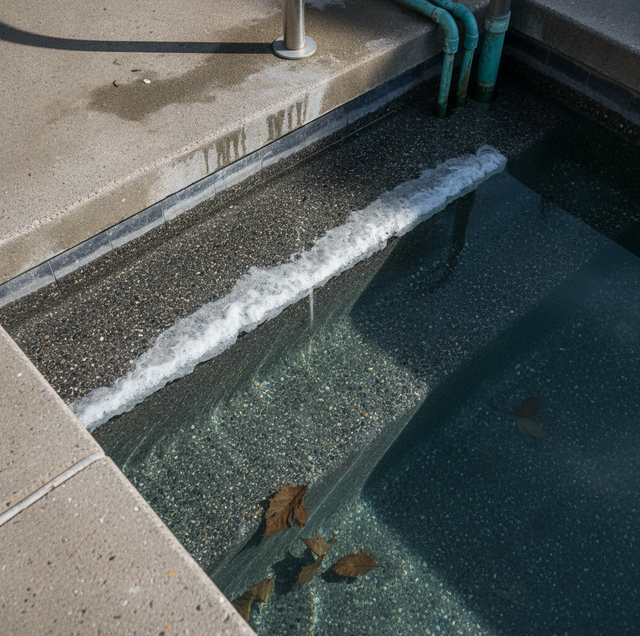
You ran your hand along the pool step, and it caught, gritty, like fine sandpaper. Or you noticed a rust-colored streak spreading from the return jet, or a chalky white line riding at the old waterline. A pebble finish is supposed to feel smooth-textured and look mottled and even, so when it turns rough or stained, something in the water or the surface has changed. The good news is that most of these changes trace back to a short list of causes, and once you know which one you have, the fix is specific rather than guesswork.
Quick Answer: A rough Pebble Tec surface is usually covered with calcium scale that builds up on and between the pebbles from hard or unbalanced water. However, etching from aggressive, low-pH water and years of normal wear also roughen it. Stains come from metals like iron and copper, from organic debris and algae, or from scale discoloration. The color and the feel tell you which one, and each has a different fix.
What a Pebble Finish Actually Is
Pebble finishes, sold under names like Pebble Tec, are a blend of small natural pebble aggregate suspended in a cement (Portland-based) matrix, troweled onto the shell and then exposed so the stone reads at the surface. That construction is why the finish lasts far longer than plain plaster and shrugs off a lot of abuse. It is also why the two problems you notice, roughness and staining, behave the way they do. The pebbles themselves are hard stone and do not really change. What changes is the thin layer of water chemistry sitting on and between them, and the cement that binds them.
Think of the finish like a cobblestone street. The stones are set in mortar. If mineral crust builds up over the stones, the street feels rough in a new way that was added on top. If the mortar between the stones wears down and washes out, the street feels rough because the stones are now standing proud and loose. Both feel bumpy underfoot, but one is material added, and the other is material lost, and you fix them from opposite directions.
Why the Surface Turns Rough
Scale: The Number One Cause of That Sandpaper Feel
The most common reason a pebble surface goes gritty is calcium scale. When the water carries a lot of dissolved calcium and the balance tips toward high pH and high alkalinity, that calcium comes out of solution and deposits as a hard mineral crust. On a pebble finish, it settles on top of the stones and packs into the low spots between them, resulting in exactly the sandpaper texture people describe. It is material added to the surface, which is important because it can be removed.
Scale tends to show up first at the waterline, around returns and steps where water moves and evaporates, and on the shallow-end shelf. Early on, it is more felt than seen. Left alone, it thickens and can start to look like a dull gray or white haze over the pebbles' color.
Etching: When Aggressive Water Eats the Cement
The opposite chemistry causes the opposite problem. When water runs persistently acidic, with low pH, low alkalinity, and low calcium, it becomes hungry for minerals and pulls them out of the cement matrix that holds the pebbles. As that binder erodes, more of each pebble is exposed, and the surface starts to feel like loose, protruding stone. This is roughness from material lost, not gained, and it is the cement, not the stone, that is disappearing.
Normal Exposure Over the Years
Even with well-kept water, a pebble finish weathers slowly. Years of brushing, swimming, sun, and chemical cycling wear the surface cement back a little, and the exposed-pebble texture becomes slightly more pronounced. This is the finish aging rather than a chemical fault, and it is why an older pool can feel a touch rougher than it did when new, even though nothing is wrong.
Why the Surface Gets Stained
Staining is a separate category from roughness. A stain is a discoloration, and unlike scale, it is often only skin deep and does not change the texture at all. The cause usually announces itself in the color.
Metal stains are the classic culprit. Iron leaves rust-orange and reddish marks, and copper leaves blue-green or teal ones. These metals ride in on well water, on corroding equipment, or sometimes on certain algaecides, and they plate out onto the finish where they discolor the pebbles and cement.
Organic stains come from the yard. Leaves, seeds, berries, and other debris that sit on the surface leach tannins and leave brown or yellow-brown marks, while algae that gets a foothold in the texture leaves green. Because a rough surface holds debris and shades pockets from circulation, roughness and organic staining often travel together.
Then there is scale discoloration, where heavy calcium buildup itself dulls and whitens the color, and the thin white calcium film that can haze the whole waterline. That overlaps with the roughness story because the same mineral is behind both.
Why It Is Worth Fixing
Rough is not only a comfort problem, though scraped feet and snagged swimsuits are real. A rough surface has vastly more surface area and countless micro-pockets, and those pockets grab dirt, hold organic matter, and give algae somewhere to anchor out of the reach of circulation and brushing. So, roughness quietly makes the pool harder to keep clean and clear, which is why it tends to compound if ignored.
Stains are mostly cosmetic. A metal or organic stain will not hurt the structure of the finish. What a stain does is act as a readout on your water: a fresh crop of metal staining tells you there is iron or copper in the water, that your balance is letting it plate out, and that the same water chemistry has other effects you would rather get ahead of.
How Each Problem Is Actually Fixed
The single most powerful tool is also the least dramatic: balanced water. Holding calcium hardness, pH, and total alkalinity in their proper ranges is what stops scale from depositing and stops aggressive water from etching. Balance is preventive against both causes of roughness at once, and it is the foundation on which everything else sits.
For a scale that has already built up, a professional can smooth the surface back down. Bead blasting or media blasting uses a controlled abrasive stream to knock the mineral crust off the pebbles without carving into the stone, and a carefully managed acid treatment can dissolve calcium buildup. Both are strictly professional jobs. Acid handling and pressurized blasting carry real risks to the finish and to the person doing the work, and overdoing either can strip cement and worsen the very texture you are trying to fix. This is not a weekend project.
For metal stains, the approach is chemical, not mechanical. A stain treatment or sequestrant matched to the specific metal lifts and holds the metal, so it stops discoloring the finish; scrubbing does nothing for a true metal stain, essentially. For organic stains, correcting sanitation and gentle brushing usually clears them, and keeping the surface brushed keeps new debris from setting in.
A word on what not to do. A pumice stone or a stiff abrasive pad feels like it is working because it takes the top layer off, but on a pebble finish, it gouges the cement, roughens the surface further, and leaves it holding dirt faster than before. Harsh do-it-yourself abrasion is one of the quickest ways to turn a small problem into a permanent one.
Telling the Three Apart Before You Spend a Dime
Because the fixes are so different, the diagnosis is the whole game. Scale-rough is a crust added on top that is removable. An etched or worn pebble is the finish itself, having aged and lost cement, which is a resurfacing conversation rather than a cleaning one. Stains are chemical discolorations that usually leave the texture alone. Run your hand over the surface, look at the color, and note where the trouble sits, and you will usually land on the right category before anyone touches the pool.
Very hard water is worth naming here because it carries a heavy mineral load that makes scale the dominant roughness complaint. But hardness cuts both ways: the same mineral-rich water that scales a poorly balanced pool will, if the chemistry is pushed too far the other direction to fight that scale, tip into etching. The answer with hard water is not to swing to one extreme but to hold the balance steady, which is exactly what keeps a pebble finish smooth-textured and evenly colored for the long run.
Frequently Asked Questions
Where the roughness sits is a strong clue. Scale settles at the waterline and around the returns, the places where water either evaporates or keeps moving, so a gritty band that follows those lines points to a mineral deposit. True wear reads differently: it shows up uniformly across the whole surface, floor, and walls alike, because every square inch has seen the same years of brushing and swimming. So a finger test tells you the type, but mapping where the rough zones fall tells you the cause, and that in turn decides whether you are looking at removable crust or an aging finish.
The color points to the source. Rust-orange and red come from iron, blue-green from copper, and a purple-to-black stain from manganese, another metal that can ride in on fill water. Brown or green marks come from organic debris and algae. Timing matters as much as color, because a fresh stain often lifts with prompt treatment while one that has had months to bond into the finish needs a stronger, targeted removal. So note both the shade and how long it has been sitting before you pick a product.
Pool pros track this with a saturation index, the LSI, that combines calcium, pH, alkalinity, and water temperature into a single reading. When that number swings positive, the water is oversaturated and drops scale onto and between the pebbles; when it runs negative, the water is hungry and etches the cement binder instead. That is why the target is a balanced middle rather than chasing any one figure. Two pools can share the same calcium level and behave in opposite ways once temperature and pH are factored in, which is what the index is built to capture.
Yes, but it has to be done carefully by a professional. A pro can bead-blast or media-blast the scale off the pebbles with a controlled abrasive stream, or use a managed acid treatment to dissolve it. Both methods can take the mineral crust off cleanly when done right. A pumice stone or harsh scrubbing, by contrast, gouges the cement matrix and leaves the surface rougher and quicker to trap dirt, which is why the removable-scale case still belongs in professional hands.
Metal stains respond to chemistry, not muscle. You use a stain treatment or a sequestrant matched to the specific metal rather than scrubbing, because scrubbing will not lift a plated-out metal. Keeping a sequestrant in the water then holds the iron or copper in solution so it stops redepositing onto the finish. That is why identifying the metal first matters: the right product is metal-specific, and the wrong one may do nothing.
The cadence matters more than any single treatment: brush weekly and test the water regularly so balance is corrected before it drifts far enough to deposit or etch. Where the fill water itself is extremely hard, that routine can lose ground because every top-off adds more minerals than brushing removes. In that case, a partial drain-and-refill, or a filter fitted to the fill line, lowers the mineral load that keeps rebuilding the scale. Set the routine to match how hard your source water actually is, and the finish holds its texture and color far longer.
Book a professional pebble-finish assessment — get the right fix instead of a guess. Pool Tile Cleaning Vegas serves Las Vegas, Henderson, and North Las Vegas. Call (702) 743-8142.
